

While composing a new piece for a collaboration, the process quickly surfaced a principle that I am reminded of each time I start a new work.
The Short Story
It is our job to break rules and most rules can be broken. But if you break the few rules that truly matter, they will break you.
Humans create things.
We codify the processes of those things into systems.
Systems turn into conventions.
Conventions get copied, repeated, and monkeyed blindly until the original purpose is lost.
Most rules are noise because they are created by humans who are just using their current tools and knowledge to solve problems. They are imperfect, malleable, and they often continue to be used long after expiration.
Beneath human-made rules are the real operating functions, the fundamentals.
The Long Story (A Somewhat Coherent Illustrative Rant)
In music school, I gravitated toward the few others who had a dream.
They were going to be a composer.
Such a cool endeavor. There’s a mystery, a romance in that word, composer. You get to be a wunderkind, a creative genius, and probably the next John Williams.
As the work begins, the first assignments are easy. You get some quick wins to build confidence.
Soon the pain begins and you start to hear gripes around the room:
George: “Why is music theory so hard?”
Abu: “I can’t make real music with all these stupid rules.“
King Louie: “I feel like I’m just doing a bunch of math.”
Bubbles: “I thought music was supposed to be fun.”
You watch the light fade, then it goes out. The romance dies. Students drop off one by one and they never write music again.
It’s not their fault. They can’t see the forest for the trees. They don’t know the difference yet. They have to trust the system until they get through it sufficiently to eventually discover what the system was built upon and that there are only a handful of fundamentals that need to be understood to accomplish what they want to do.
Unfortunately, unless you have the right mentor or a system of teachers reminding you why you’re learning this stuff and keeping the fire/romance burning, it’s easy to believe that composing is nothing but dry, abstract theory.
If you manage to continue through the system, you discover that the strictness gradually unravels and there are a lot of liberties that can be taken.
Romance potentially restored.
Still, unless you are particularly observant and “march to the beat of your own drum” to an extent, or otherwise have a mentor providing the larger perspective (the few rules that matter and how they apply to your goal), you might never realize what is actually important and what isn’t.
Likewise, a clear sense of self, a specific sound you are chasing, or any clear goal met with determination helps filter out the noise (unnecessary rules and conventions) because you operate with a hunger to know what actually works to get what you want.
Non-essential-rule enforcers will still be around every corner, sometimes between you and a potential opportunity. And this is just a symptom of another system at play that further detracts from what is important.
There is a high probability that your professors, a majority of whom are now replaced by more-affordable non-tenure-track teachers, haven’t stepped a single foot outside of the system they were born into.
Grade school → college → grad school → college faculty
It’s a closed loop. And like any system filled with anxious minds chasing importance, it breeds hierarchy, self-protection, and endless rituals of status.
If you keep monkeys in an enclosure long enough, the walls become invisible to them, and strange behaviors develop.
When daily survival/signal-angst replaces a clear drive toward an agreed upon mission, there is no mission. You’re left with a system of patched rules that continues to warp and eat itself by producing behaviors that were never intended. The success of each student toward their individual goals becomes secondary, tertiary, and further down the priority list.
This is getting pretty dark, so I’ll turn it around here, lol.
To be clear, my time spent in such a system was hugely beneficial and I recommend it to anybody with a clear goal in mind and the ability to filter through the unnecessary, which is often a byproduct of being a little older when you start, but not always. It’s often isolating as well, but so is independent thinking.
Another symptom of such a system (the view from the outside world) is that you have the excuse of being a “student,” which means you are expected to spend all of your time studying and practicing. If used wisely (in pursuit of a specific goal) you can make a lot of progress in less time than it might take otherwise. It also forces you to internalize some of the fundamentals through exercises, whether you appreciate it at the time or not.
I had a professor (primarily a composer in the real world) who was seen as a bit unhinged and known to clash with his peers and “superiors.” But his form of rebelliousness always seemed rooted in what was truly important. He could see the walls of the enclosure and the ridiculous behaviors that developed within those walls by people who lost the point, so he would call them out. Students would frequently be asking about their grade and he would always respond, “Stop chasing grades. They don’t matter in the real world. Just keep writing music.”
The person who decides they will find a way to be an effective composer (or anything else) and make it work for them will. Whether through research, analysis, or tons of trial and error, the fundamental functions will present themselves.
I’ve found that simply being aware of the underlying functions and constantly returning to them removes a lot of the noise and makes music creation incredibly versatile and exciting.
Even if you make music with a lot of actual aural noise, it’s incredibly helpful to be able to recognize and consciously guide the elements that are functional (telling the real story) versus purely aesthetic. Without a clear separation, it can be easy to fall into the trap of making something seem interesting or complex but that falls flat on the listener due to a lack of function.
An understanding of the fundamentals allows you to discern between aesthetic complexity and functional complexity.
You can take a rich (complex) sound world and tell a simple story with a lot of color and attitude.
Conversely, you can take a single melodic line with a basic sound and elevate it with rich functional story-telling elements.
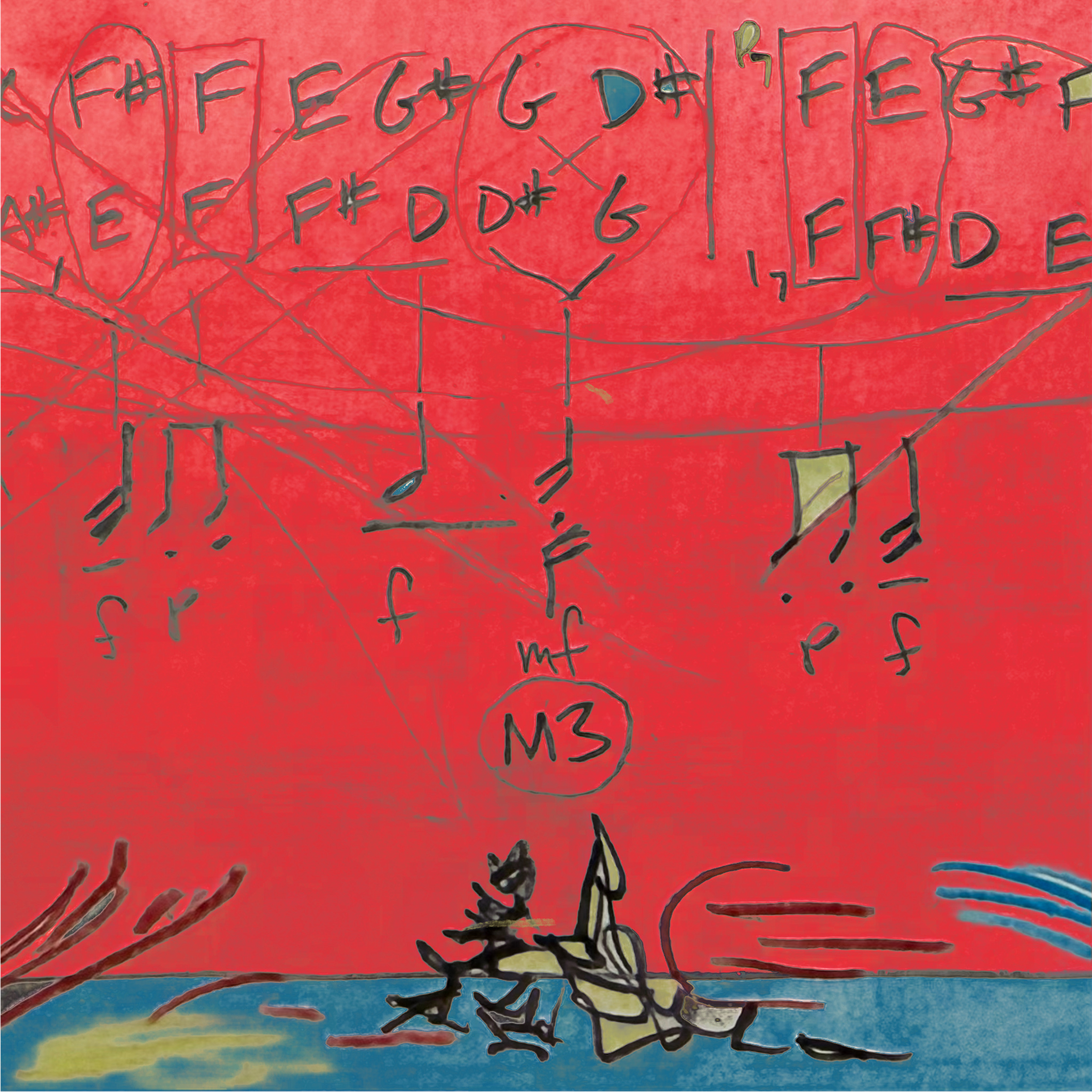
So when starting this new composition, I was initially thinking, “Okay, the nature of this collaboration has a path of logic that says it might be a good idea to write in the 12-tone style of Schoenberg.” It does make sense, but it’s only one approach of many.
12-tone music comes with a strict set of rules, one of them being that you can’t repeat a note until all 12 have sounded. There are some clever ways around this by using more than one set in canon and such, but it still poses a very strict system to adhere to.
As I began, it was really fun writing down the tone row I chose and finding cool harmonies that lined up with certain forms of that row from the 12-tone matrix. But the music kept resulting in a dryness that I didn’t like. Maybe I’m just not clever enough with this system, but I’ve heard enough of it that I can say it doesn’t satisfy my sonic needs.
And though Schoenberg was a brilliant composer, he was demonstrating a new system he invented, a new way of approaching music composition. His music has moments of transcendence, but can often feel “mathy” and wandering. It’s clever and it’s a different way of hearing linear relations. It works as an observation of a system and it has an overarching color that is hard to escape when using all 12 tones in every piece.
I get excited by more specific tone colors, gestures, and forward motion. I like an approach to composition that is very much rooted in the principles set forth by Schoenberg but more specific and more focused on intervallic content and smaller pitch sets. Closer to the approach of his student Webern’s work and Stravinsky, but of course with modern elements.
So I make this decision and remain conscious that I’m moving away from the color/sound world aesthetic that comes with strict 12-tone rules. I’m aware that this an aesthetic choice, not functional.
I also make the realization that the underlying function of 12-tone music is not necessarily to try to tell a story as in the fundamental functions of tonalism (tension-release, goal-directed motion, hierarchy). Though some of these can exist, the focus is more on demonstrating the relationships between transformations of the established 12-tone row.
I like music to go somewhere, to tell a story, even if that story is sometimes contained within a single gesture. I get bored writing tonal music, but I love listening to someone who has perfected it like Bach. I get bored writing 12-tone or serialism but I love listening to Schoenberg and Stockhausen in small doses.
What I really love is the freedom of building a specific voice through specific tone-color and phrasing and using the underlying functional devices that were established by tonalism without being constrained by the diatonic scales. There is still a system, a certain strictness, a consciousness of how one’s established set of intervals and gestures are being implemented. It is not totally free atonality. There are wrong notes, dysfunctional phrases, and other such things to avoid. This is where I thrive.
The collaboration piece hasn’t fully been written yet and the artist’s visual work will inform the aesthetic of the music, and the rest will be guided by function.
In the end, I’m just monkeying the attitudes and aesthetics of my favorite composers and bands, and following what feels like natural curiosity/impulse. Much of it is on purpose, but I’m sure there are some weird social/stylistic assumptions at play within an invisible enclosure that I’m not aware of (perhaps all of it).
All I can do is maintain consciousness of the fundamental functions, the rules that can’t be broken…
Pattern
Tension (dissonance)
Release (consonance)
Contrast
Motion
…because that’s what makes the music actually work.

Thanks for reading,
-LW❤️🔥